
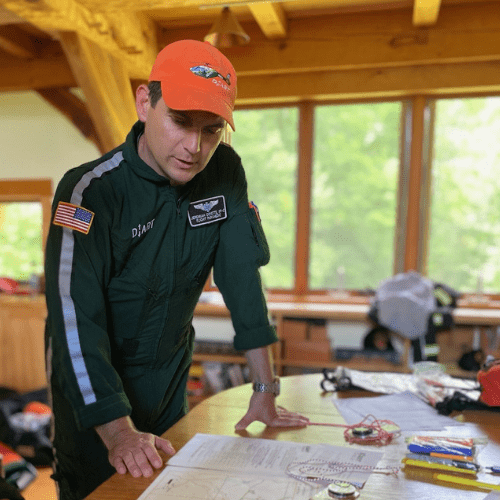
Jeremiah Goyette

FP-C

Flight Paramedic
DHART

Lenanon, NH

Jeremiah Goyette is a HEMS Paramedic with DHART Air Ambulance. Drawing on nearly two decades of experience in critical care transport and helicopter emergency medical services, along with his background as an instrument-rated pilot, his work focuses on the intersection of aviation and medicine. Jeremiah is particularly interested in translating aviation safety principles into everyday clinical practice, operations, and training, with an emphasis on risk management, error prevention, crew performance, and safe operations in dynamic, high-risk environments. He is passionate about developing realistic, meaningful educational experiences that prepare crews to perform effectively under pressure, uncertainty, and complexity. His areas of special interest include crew resource management, single-pilot resource management, aircrew emergency training, aviation survival, and the human factors that influence decision-making and safe performance. Through education and operational experience, Jeremiah is committed to helping air medical professionals strengthen teamwork, improve safety, and deliver exceptional patient care in challenging environments.

Beyond the Checklist - Risk Assessment in Error & Accident Prevention (Thursday, October 22, 2026 - 2:15-3:30pm)

Medicine’s adoption of the aviation checklist concept has produced significant improvements in patient safety, clinical outcomes, and harm reduction. By introducing structured, standardized steps into complex procedures, healthcare teams have reduced variability, improved communication, and prevented avoidable errors.

However, aviation safety experts increasingly emphasize that checklists alone represent a reactive model. While they help crews respond to known situations, they do not always anticipate evolving risks. This has led to a shift toward more comprehensive systems that identify and assess both static risks (known hazards) and dynamic risks (changing conditions such as workload, environment, or system failures).

This lecture will examine how proactive safety strategies from aviation can be applied to healthcare. Through an aviation accident investigation paired with a medical case scenario, participants will explore how decision-making, situational awareness, and risk recognition influence outcomes in both fields.

The session will also explore the “shape of risk,” including measurable hazards and contextual factors such as human behavior, team dynamics, and system design. Participants will be introduced to risk-assessment tools that help move beyond checklists and toward proactive, system-level approaches to safety.