
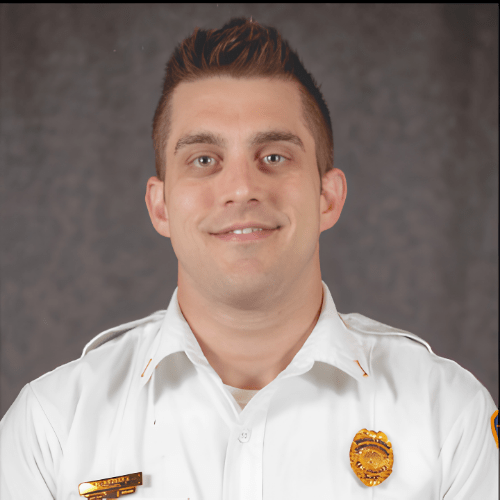
Training and Safety Captain
Fairmont Fire Department
Fairmont, WV
Dustin Lambert has more than 24 years of fire and emergency services experience and currently serves as a career Captain with the Fairmont (WV) Fire Department, where he manages the department’s training, inspection, and safety division. He holds a doctorate in Emergency Management from Jacksonville State University, a master’s degree in Safety Management from West Virginia University, and a bachelor’s degree in Occupational Safety from Fairmont State University.
Dustin’s research expertise focuses on responder safety and health, with an emphasis on human factors and emergency vehicle crashes. He is a West Virginia state fire and EMS instructor, an instructor for the National Fire Academy’s Responder Health and Safety curriculum, a National Fallen Firefighters Foundation Fellow, and an FAA-licensed private pilot.
Despite decades of EVOC training programs and driver safety campaigns, emergency vehicle crashes remain one of the leading causes of traumatic line-of-duty deaths. What’s missing? The role that the driver’s psychological state plays —and how accute stress silently hijacks decision-making ability, risk perception, and situational awareness behind the wheel. This session exposes the cognitive blind spots in traditional driver training and presents findings from the presenter’s doctoral research spanning over 20 years of data on fatal fire apparatus crashes and the human factors that lead to them. Drawing on neuroscience, crash data, and case studies, the session explores how stress affects emergency vehicle operators in the moments that matter most. In addition to fire service data, this course integrates lessons from the aviation industry, where human factors, mental workload, and cockpit resource management have been studied and mitigated risk for decades. These proven aviation strategies are adapted for the emergency response environment to enhance situational awareness, improve crew coordination, and support stress-resilient driving. Attendees will learn to identify sources of acute stress, understand how it impacts driving performance, and apply science-based techniques to manage it in real time. Whether you’re a driver/operator, company officer, chief, or training officer, this course offers actionable strategies to reduce crashes, strengthen training programs, and build a culture of stress-aware driving in your department. Don’t just train to drive—train to drive under pressure.