
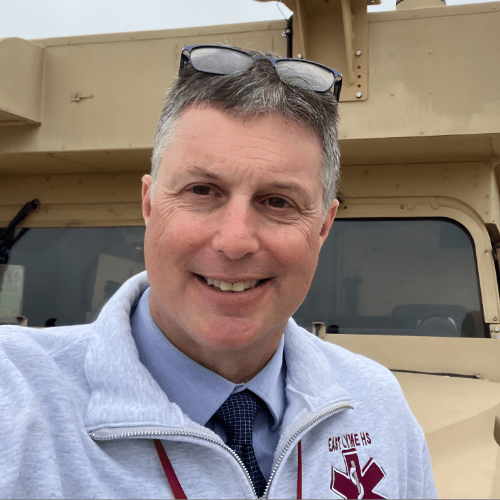
EMT
East Lyme HS Assistant Principle, Pathways Supervisor
East Lyme High School
East Lyme, CT
David Fasulo is the Assistant Principal at East Lyme High School, where he oversees the school's EMT Certification Program. A certified EMT for more than 20 years, David is also the author of several outdoor books, including How to Rock Climb: Self-Rescue, a standard reference on technical self-rescue skills that has been translated into multiple languages. An accomplished offshore sailor, he serves as the medical officer for the Newport to Bermuda and Marblehead to Halifax ocean races.
Together, David along with Mary Turano have develop one of Connecticut's premier high school EMT education programs, preparing students for careers in healthcare and emergency medical services.
The East Lyme High School EMT Certification Program is recognized as one of the most comprehensive programs in the state. The program has developed several unique partnerships, including Combat Medic Training with the Army National Guard, a collaboration with the UCONN School of Pharmacy, and a Global Language patient assessment component.
With a focus on innovative education, real-world experience, and preparing the next generation of EMS providers, the program has achieved an NREMT exam pass rate that is currently higher than the national average.
Come learn what makes the East Lyme High School EMT Certification Program such a successful model and discover the partnerships, training opportunities, and educational strategies that have contributed to its continued success.
Rural emergency medicine demands a different mindset, and in many parts of Kansas, that reality is lived every day. Patients arrive just as sick—or sicker—but with fewer personnel, fewer resources, limited specialty support, and transport distances that routinely extend far beyond urban norms.
This session explores the clinical and operational challenges of managing high-acuity patients in rural and critical access settings, where EMS providers and emergency clinicians must make early, high-stakes decisions with little margin for error. Drawing from real-world experience in rural EMS systems and a Critical Access Hospital emergency department, this presentation examines common high-risk scenarios, including severe trauma, cardiac emergencies, sepsis, airway compromise, and rapidly deteriorating medical patients.
Emphasis will be placed on early recognition, prioritization of interventions, resource management, and anticipating downstream complications long before definitive care is reached. Through case-based discussion, attendees will gain practical insight into how rural EMS agencies and emergency departments function as a single, interdependent system—and how sound field decision-making can significantly influence outcomes when resources are limited and help may be hours away.